

Intel Core i3-9100F vs. Ryzen 5 1600 AF
Having recently reviewed the Ryzen v 1600 AF, yous should know all in that location is to know about this nimble CPU. How it performs, where you can buy information technology, what you need to support it, and so on. In brusque, it'due south an incredible value and if you're lucky enough to have it available in your region and desire something for under $100, there's simply no better option, or at least that'due south our opinion.
However we've seen some replies claiming the Core i3-9100F is a meliorate selection. Information technology's also cheaper and more widely available, so at that place is that. It happens to be one of Intel's near pop CPUs correct at present as information technology costs only $fourscore, so earlier we get into the benchmarks, let's hash out Intel'south upkeep processor.

The Core i3-9100F is a 4-core/four-thread Java Lake CPU, which means it's almost identical to an 8th, 7th and 6th-gen quad-core. Information technology's also not overly different to a 4th-gen Haswell quad-cadre except for the upgrade to DDR4 memory.
Been there, done that.... as a 6th-gen office information technology'south basically what we knew equally the Core i5-6600, which retailed for $215. As a 7th-gen part information technology'southward close to the Cadre i5-7600, which also retailed for $215. And so for the 8th-gen series, quad-cores were rebranded for the first fourth dimension as Core i3, though they didn't support Turbo Boost. The 9th-gen i3-9100F is about the same as an i3-8100 but with Turbo enabled, supporting upwards to 4.2 GHz for single cadre workloads.

Taking this into consideration, the 9100F is more than like a Core i5-7600K as it also additional to 4.2 GHz, though it featured a higher base clock at 3.8 GHz, whereas the Core i3-9100F can drop equally low equally 3.half-dozen GHz. Going through the specs as nosotros just did, information technology seems clear at that place's going to be very footling delta when comparison the 7600K and 9100F at least out of the box. The older Core i5 does become overclocking as a 'Yard' part, whereas the 9100F is locked regardless of the chipset used. Only with a Z-serial motherboard the Core i3 processor does support retentiveness overclocking.
This begs the question, why were Intel fans challenge the 9100F would grit the 1600 AF, when in that very review we included Core i5-7600K results? Whatever the case, today nosotros're putting them head to caput in an endeavor to make up one's mind which budget CPU you lot should invest in.

Permit's jump into the bluish bar graphs and do our affair. For testing the i3-9100F we used a Gigabyte Z390 Aorus Ultra equipped with DDR4-3200 CL14 memory. The same retentiveness was used for all other processors, as well as an RTX 2080 Ti graphics card to reduce potential GPU bottlenecks. This allows us to look at the CPU operation, rather than the GPU performance every bit this isn't a mid-range GPU review…
Benchmark Time
Correct off the bat we have Cinebench R20 multi results, and the margins you come across here will interpret to whatsoever application that can utilize half dozen cores or more than: basically whatever video editing tool, 3D rendering awarding, code compiler, and and so on.
These are also things budding creators volition 100% desire to do with a budget processor such as the Ryzen 5 1600 AF. These aren't merely general purpose processors for word processing, web browsing and emails, though given the results here the Core i3-9100F may be better suited for such a use case.

The 1600 AF was 76% faster in Cinebench R20, thanks to the fact that it packs ii extra cores with SMT support for three times as many threads. As well as expected, the 9100F is very similar to the Core i5-7600K with nigh identical results in this exam.

The 9100F does enjoy single-core clock speed advantage, whereas the 1600 AF will but clock equally high every bit 3.6 GHz, the 9100F boosts 17% higher to iv.2 GHz. Despite that pregnant clock speed advantage, due to second-gen Ryzen'due south potent IPC functioning, the 9100F is only iv% faster than the 1600 AF when using a single cadre, in a workload that'southward not peculiarly memory sensitive.
The 1600 AF is also an unlocked part and with a cheap $20 tower cooler it tin exist typically overclocked to around 4.2 GHz, so well-nigh a 15% increase in clock speed over the out of the box spec.

Taking a look at functioning in 7-null we see that the 1600 AF is almost twice as fast as the 9100F for compression work, here information technology was a whopping 93% faster. In fact, the Ryzen processor was just 11% slower than the Core i7-8700K and in a completely different league to the Core i3 model.

When it comes to decompression piece of work that figure is blown out to a massive 127% margin, making the Ryzen CPU worlds faster than the 9100F and just iii% slower than the 8700K.

It'south total anything in Blender as well. Here the 1600 AF was 85% faster than the 9100F. Again it makes more sense, at least in terms of performance, to compare the Ryzen 5 part with the Core i7-8700K, as it was just 13% slower in this test.

The 9100F has the advantage of using less power, simply when comparing total system usage, it'southward actually worse in terms of performance per watt. Here the 1600 AF consumed 50% more power, but it was 85% faster, so significantly more efficient and that'due south largely due to it's SMT support.
Gaming Benchmarks
For playing games on a budget CPU, first up we take Assassin's Creed: Odyssey. This game punishes quad-cores and as you lot'd expect, the 9100F fairs no ameliorate than the 7600K. Granted we're notwithstanding looking at playable functioning with the quad-cores, merely frame stuttering volition be much more credible with these CPUs.
The 1600 AF on the other hand is silky smooth with one% lows of around 60 fps and an average frame rate of 77 fps, making the Ryzen processors 24% faster than the Core i3.

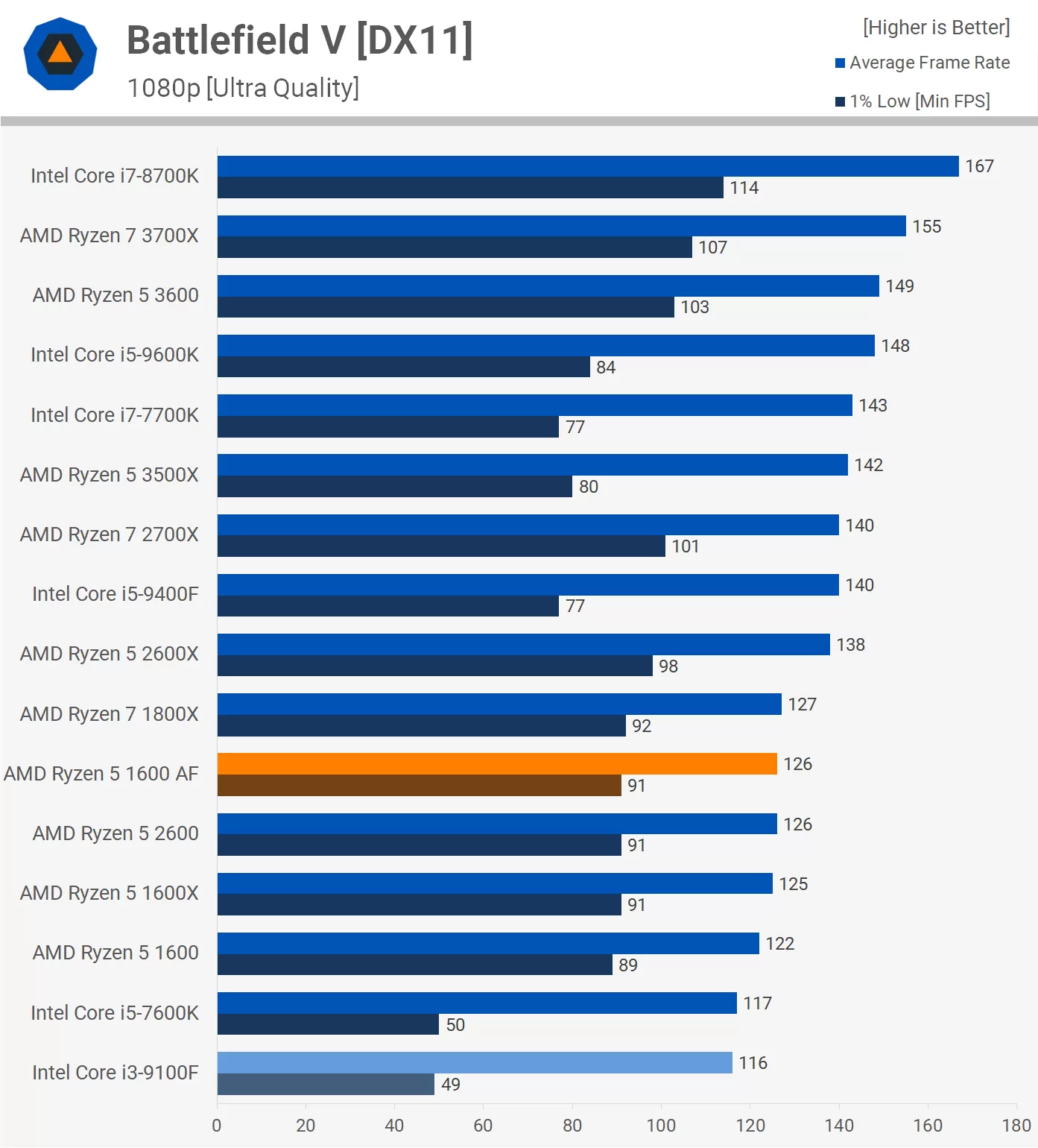
Battlefield V is even more enervating that Assassin'southward Creed: Odyssey and here frame stuttering is a massive problem with the quad-cadre scrap. At that place is a 137% functioning disparity between the 1% low and average frame rate with the 9100F, while we only encounter a 38% disparity with the 1600 AF.
The Ryzen v function was 9% faster when comparison the boilerplate frame rate, but a massive 86% faster when looking at the 1% low results.
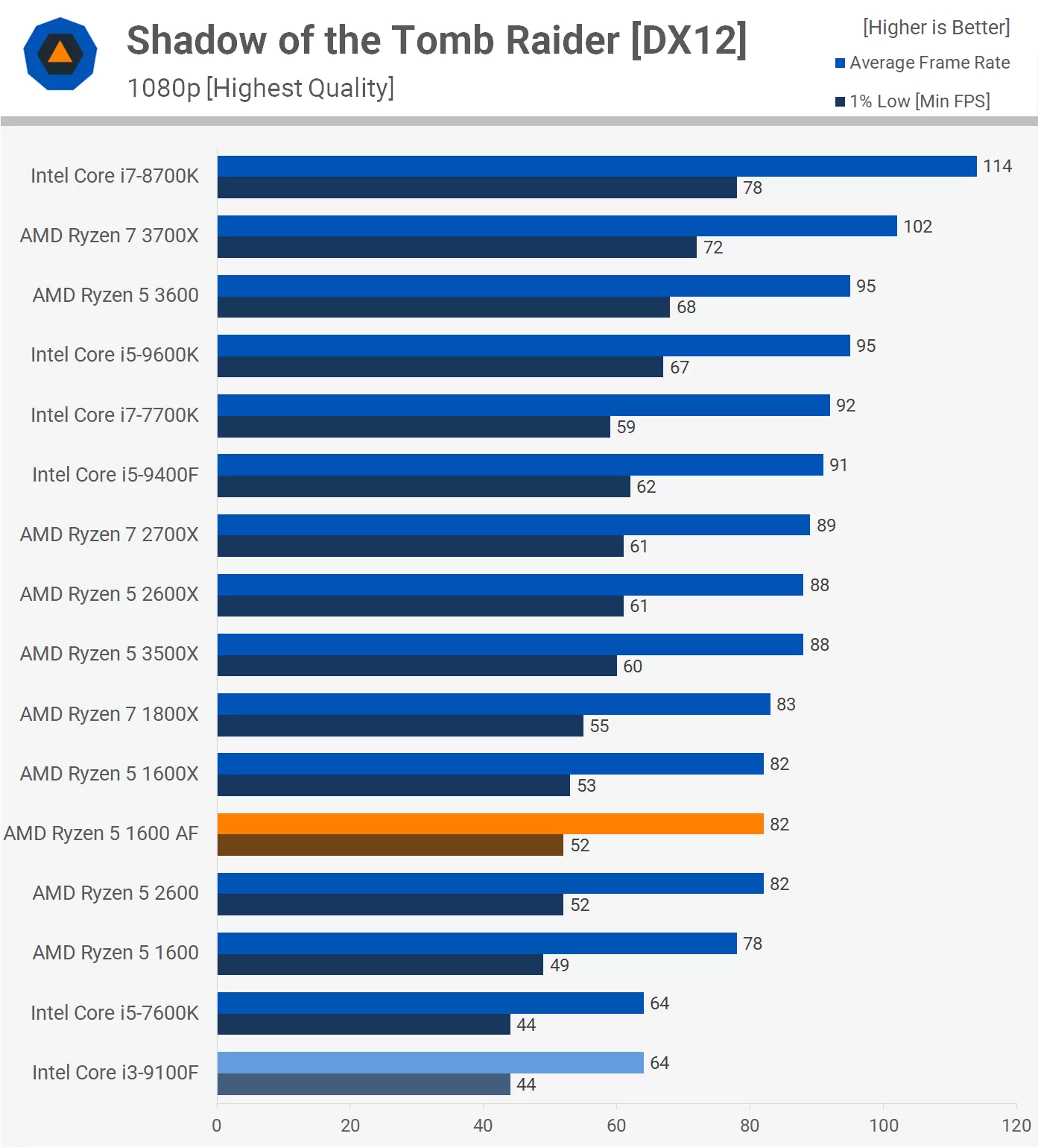
Shadow of the Tomb Raider is another modernistic CPU demanding title and hither the 1600 AF was upward to 28% faster.

The Division ii is an ever CPU enervating title and hither the 1600 AF was 43% faster than the 9100F when comparing the boilerplate frame rate and 33% faster for the ane% low result.

Far Cry New Dawn isn't a CPU enervating game, at least not in the sense that it utilizes core heavy CPUs very well. However, we include this title deliberately as it's a skillful example of how some older titles carry with mod processors.
Information technology'south likewise important to note that while the 9100F is fourteen% faster than the 1600 AF, the Ryzen 5 processor however allowed for over 60 fps at all times and didn't endure from poor frame time performance, the game played very smoothly.

Hitman 2 typically isn't a great championship for Ryzen CPUs, the 3rd gen Ryzen 7 3700X falls short of even the Core i7-7700K for instance. However, this title also requires more than 4 threads. In the case of the 7700K it skates past thanks to Hyper-Threading support. The 7600K though struggles and it's the exact same story with the 9100F, the game is still playable and relatively smoothen, merely the 1600 AF does have a clear advantage here.

Finally we take the Total War: 3 Kingdoms results and again, the 1600 AF edged out the 9100F, this time allowing for 10% more frames on average and a 23% improvement in i% low performance.
Wrap Up
We don't recall this comparison calls for any further analysis. It's plain clear that if you lot want to build a upkeep gaming PC, investing in a quad core to save even $50 is not worth it. You volition have to deal with frame stuttering in a number of more demanding titles, old and new.
The quad-core Core i3-9100F was hopeless in Battlefield V, pretty bad in Assassin'south Creed: Odyssey, fairly useless in The Division 2, and weak in Shadow of the Tomb Raider. When playing older or less demanding titles such every bit Far Cry New Dawn, the Cadre i3 did well, but so volition the 1600 AF or whatsoever other hexa-core or better Ryzen processor.

We're not far from reaching a point where quad cores volition exist unusable for serious gaming, so investing in i today to save a small amount of coin is manifestly silly. For US-based shoppers, the Ryzen 1600 AF effectively eliminates the Cadre i3-9100F as both come in at about $85. Your mileage will vary in other regions where the 1600 AF may not be as inexpensive or may be entirely unavailable.
Where y'all can't get the 1600 AF, the side by side best thing is the Ryzen 5 2600 at $120. That's a hefty 41% increase in price though. Alternatively, you will get a similar experience to that of the 9100F with the Ryzen 3 3200G for $94. That's a mere $11 increase for a CPU with a decent iGPU and it'south on a platform that currently supports up to a 16-core/32-thread processor, giving yous an astonishing path for upgrades years later.
Shopping Shortcuts:
- AMD Ryzen 5 1600 AF on Amazon
- Intel Cadre i3-9100F on Amazon
- AMD Ryzen 5 2600 on Amazon
- AMD Ryzen v 3600 on Amazon
- AMD Ryzen 7 3700X on Amazon
- Intel Cadre i5-9400F on Amazon
- AMD Radeon RX 5700 on Amazon
- GeForce RTX 2070 Super on Amazon
- GeForce RTX 2060 Super on Amazon

Source: https://www.techspot.com/review/1983-intel-vs-amd-budget-cpu-battle-2020/
Posted by: rosadohildause1940.blogspot.com
0 Response to "Intel Core i3-9100F vs. Ryzen 5 1600 AF"
Post a Comment